

Advocate or Troublemaker

Advocacy did not come easily to me when I was a student nurse. As an introspective person that likes to retire into the background (and yes, I can hear my closest friends and family laughing hysterically right now) I didn’t like putting myself out there. Once I’m comfortable with people I will reveal my shoot-from-the-hip-self, but in new situations? No, they get the shy retiring me. So, when I heard I was one of “THOSE” parents. I was shocked and then I laughed at the person that said it to my face.
The person that said it to me was the CPSE/CSE chairperson in our school district. Harking back to a prior post, yes, it’s more alphabet soup—so, let me explain.
There are two committees for special education in a school district. The CPSE is the Committee on Preschool Special Education and handles children from 3-5 years old. In a small school district, the members of the committees may be the same; in a larger district they more likely have a different make-up. The CSE is the Committee on Special Education and deals with children that are school aged. In large districts the chairpersons of the committees are generally two different people. In our district it was the same person.
She had come to my home because she had heard I was a troublemaker that liked to give everyone a hard time. She walked in, introduced herself and said she wanted to meet me and go over the new IEP (Individual Education Plan) format ahead of time because she had heard I was one of “those” parents.
I had to ask her (although I suspected I already knew what her answer would be), “What do you mean by that statement? That I’m a troublemaker or an advocate1?” But first, I had to stop laughing before I could get those words out. I apologized and her response was, “An advocate?” Her slight inflection upwards won her points for wiggling out of a potential adversarial start with me.
New York state dictates what an IEP must be comprised of, but layout was left up to districts in the early 90s. Sheila’s IEPs tended to be upwards of 22 pages long, layout and formatting is important. This CPSE/CSE chairperson decided to get input from a core group of parents that she knew were meeting and working on strategies for dealing with challenging professionals.
You know, some of THOSE folks that from a parent perspective appear to put roadblocks in the way of children. (Yes, it goes both ways. Parents find some professionals hard to deal with, too.) This chairperson was going out of the way to work with parents. She wanted to make sure the layout made sense, was easy for a parent to understand and follow, and that she set a tone of cooperation with parents.
We ended up talking about how easy it was to slide into adversarial relationships when in reality both the professionals and the parents have the same goal. We all want what is best for the child. Which brought us to the next sticking point. My definition of what is best for my child is not necessarily what the professional thinks is best for my child. I let her know why I felt inclusion was the correct starting point for my daughter.
She will never keep up with her peers intellectually, but if she doesn’t know how typically developing 6, 10, 18-year-olds behave how will she get along in the world with her agemates? The goal for Sheila was never to become a rocket scientist (despite her father being a “rocket scientist” with a post-doctorate in physics), it was always to be able to interact with people in social situations. Anything academic she picked up along the way would be the bonus.
She lives in Duanesburg, therefore she needed to be educated in Duanesburg—it is one of her communities. She would grow several other communities around her, but we felt strongly it needed to start at home. Throughout her years of growing up we would drop into local businesses and people would greet Sheila. They would introduce themselves to us and tell us something about how they knew Sheila.
Time and again, it came back to meeting her in the school. They were a homeroom parent; they had assisted on set building for the musicals and Sheila was there painting the base coat on something, or some other school related connection. The school is a main hub in a small town, and we lived in a town with high parent involvement in school activities.
Once the chairperson understood our goals, she shared her goals and concerns. Both of us came away feeling heard, but we also both knew there would need to be some discussions and compromises along the way. Sheila would be transitioning from preschool/CPSE and entering the school age/CSE years. The Chairperson understood that we would all get along better if we viewed each other as advocates and not as troublemakers, we were building a coalition, a partnership not a battleground.
After we completed the formatting and layout for the IEP, which took several weeks, the chairperson suggested she continue coming over every week for an hour until we had drafted Sheila’s IEP for her first school year in the elementary building. One thing we built into her IEP was a meeting once a month with the whole team so we could touch base and make sure the plan was working.
This also gave us the option of waiving parent rights to a 10-day notification if we all felt an immediate change needed to take place. We would state, “We waive our right to prior notification2, this is now a CSE meeting.” We would then change what wasn’t working – updating her IEP. This might not work for everyone, but it not only built a wonderful working relationship that lasted throughout her schooling, it kept her in district throughout her years in school.
Learning to advocate for my patients as a young nurse certainly helped me as a parent of someone with a disability. Initially a barrier to becoming a good advocate for my child was my emotional involvement. There was personally more riding on my advocacy for Sheila than for a patient.
The final outcome was advocacy became easier as both a nurse and as a parent, thank you, Sheila. One thing that helped me was taking a 40-hour Advocacy training offered through a parent support organization. It doesn’t hurt to look around to find any kind of advocacy training, whether it is for several hours or 40.
I view advocacy as making good trouble. So maybe, I am both an advocate and a troublemaker.
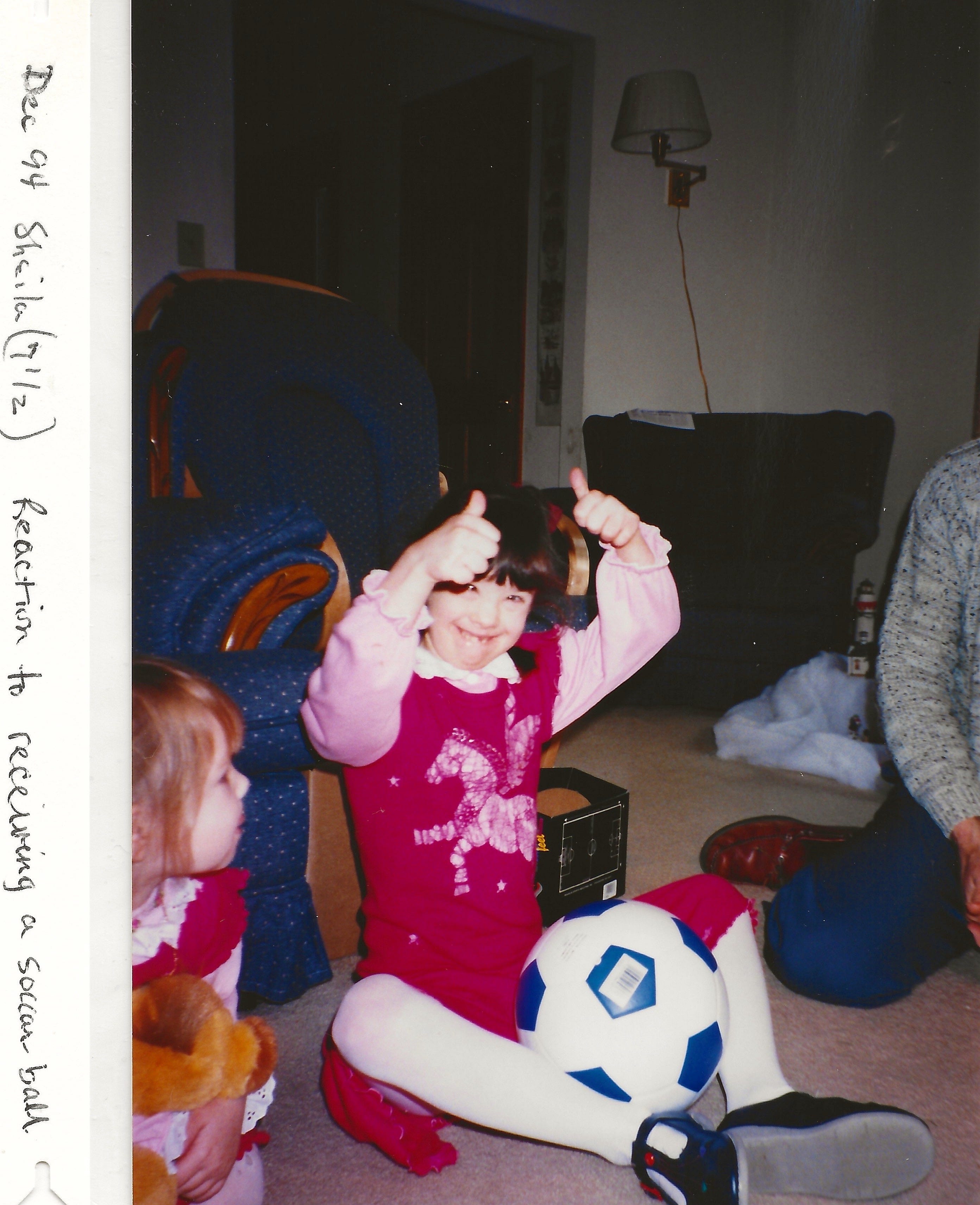



Sheila attended enough of her monthly meetings that she became one of her biggest advocates
1 David Susman, PhD, is a clinical psychologist and mental health advocate. He has an “unofficial list” of 10 qualities which he thinks exceptional advocates have. He qualities are: passionate, well-informed, great communicators, goal-oriented, connectors (able to build partnerships/coalitions, etc.), flexible, inspiring, empowering, persistent, and they are servants (as in public servants—working for the greater good, not fame or glory. For more specific information about his definitions of these qualities, https://davidsusman.com/2019/11/21/10-qualities-of-exceptional-advocates/
2 wrightslaw.com is another great source of information for learning about what your child might need educationally